
Indian mango Singapore demand is no longer a niche. What began as a category driven primarily by the South Asian diaspora in Singapore has grown into something broader, more diverse, and more compelling: an audience that includes local Singaporean consumers, food enthusiasts, and families who simply want to understand what makes Indian mangoes different from the tropical fruit they already know.
The 2026 season gave Berrydale Foods the most significant platform yet to demonstrate exactly that.
Across the 2026 Indian mango season, Berrydale Foods supplied approximately 122 tonnes of premium Indian mangoes to Singapore across 8 varieties, participated in two landmark consumer events, and reached more than 10,000 customers through the combined programme.
This is the story of how that happened, why it matters, and what it tells us about the future of Indian mango exports to Southeast Asia.
The 2026 Indian Mango Singapore Programme: A Season Built Around Variety
Most international buyers know two Indian mango varieties Singapore consumers hear about most: Alphonso and Kesar. These are the varieties with the strongest global recognition, the most established export infrastructure, and the most visible presence in ethnic grocery stores from London to Dubai to Toronto.
But India produces over a thousand documented mango varieties. Different regions, different soils, different growing seasons, and different cultivars produce fruit with flavour profiles, textures, aromas, and sweetness levels that are as distinct from each other as different grape varieties are in wine. Building a Singapore mango programme around only Alphonso and Kesar would mean giving Singaporean consumers a single chapter of a story that spans hundreds of pages.
Berrydale Foods designed the 2026 Indian mango Singapore programme to tell more of that story. Indian mango Singapore is no longer just a diaspora product category. Across the season, we supplied eight varieties:
Alphonso: The season’s opening act, arriving around March. The internationally recognised benchmark for Indian mango quality. Deep saffron flesh, 18 to 21 degree Brix, near-zero fibre, the unmistakable floral fragrance at the stem end.
Kesar: Following Alphonso as the season progresses. Gujarat’s most celebrated mango variety, rich and sweet with a distinctive orange-gold flesh and a honey-thick flavour profile that has earned it a devoted following across the Gulf and Southeast Asia.
Dasheri: From Uttar Pradesh’s Malihabad region, arguably the mango capital of North India by production volume. Dasheri has an elongated shape, pale golden skin when ripe, and a flavour profile that is lighter and more aromatic than Alphonso, with a particularly pronounced fragrance.
Langra: A green-skinned variety from Varanasi, Uttar Pradesh, that ripens without turning yellow. Its appearance is deceptive: the skin stays green while the flesh inside reaches full sweetness and a complex, almost tangy flavour profile that distinguishes it sharply from the sweeter southern varieties.
Himayat: From Andhra Pradesh and Telangana. A large, elongated mango with firm flesh, low fibre, and a balanced sweet-sour flavour. Himayat is one of India’s most underrepresented export varieties internationally, which makes introducing it in Singapore a genuine first for many consumers at the event.
Mallika: A hybrid cultivar developed by crossing Neelum and Dasheri. It combines Dasheri’s fragrance with Neelum’s fibre-free flesh and a natural sweetness that needs no amplification. Mallika is compact, oval-shaped, and season-extending, available later in the summer when the earlier varieties have wound down.
Chausa: One of India’s most prized summer mangoes from Haryana and Uttar Pradesh. Chausa is a late-season variety, available from July onwards in a normal year. It has thin skin, extremely juicy flesh, a rich golden colour, and a sweetness level that makes it one of the highest-Brix Indian mangoes available at the tail end of the season.
Rasalu: A variety from Odisha and parts of Andhra Pradesh with a custard-like texture, fragrant aroma, and a sweetness that is complex rather than one-dimensional. Rasalu is deeply regional and rarely seen outside its home states in Indian domestic markets, let alone in international export programmes.
Offering all eight varieties across the season gave Singaporean consumers a genuine education in India’s mango diversity, not just a premium fruit purchase.
Feedback from event participants and retail buyers consistently noted that the range of flavour profiles across varieties surprised them.
Many visitors had assumed Indian mangoes were a single product category. The 2026 programme corrected that assumption directly and memorably.
How We Select and Grade Every Shipment?
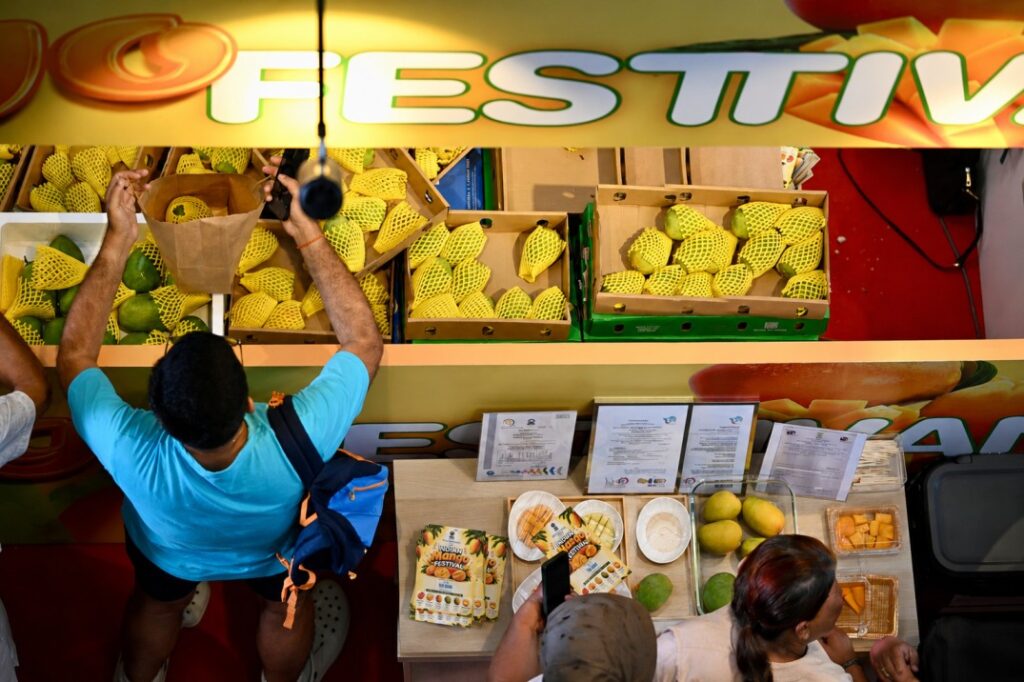
The 122 tonnes supplied to Singapore in 2026 did not arrive by accident. Behind every carton is a process that begins at the farm level and runs through four stages of grading and sorting before any fruit is packed for export.
Berrydale Foods works with a network of trusted farmers and suppliers across India’s mango-producing regions. Relationships with growers are not transactional. They are built over seasons, with consistent quality standards communicated at the orchard level so that the fruit being cultivated is being cultivated for export from the point of growth, not selected for export after the fact.
Once fruit arrives at the packing stage, the four-stage grading and sorting process assesses fruit quality, consistency, size uniformity, skin condition, and ripeness.
Damaged, blemished, or inconsistently ripened fruit is removed at each stage. Only fruit that meets the export quality standard at every checkpoint progresses to packing.
Sweetness is assessed using a Brix meter. Berrydale Foods targets mangoes with a Brix level of 15 degrees or above across the Singapore programme.
This threshold ensures that every variety, regardless of how sweet or mild its natural profile is relative to Alphonso, arrives with sufficient natural sugar concentration to deliver a satisfying flavour experience.
This quality threshold matters particularly in the Singapore market, where consumer expectations for premium fresh fruit are high and where a disappointing first experience with an unfamiliar Indian variety can close a door that takes years to reopen.
Every variety in the 2026 Indian mango Singapore programme was quality-checked to this standard before departure.
Mango Fiesta 2025 at Clarke Quay: Where the Singapore Story Began?
The foundations of the 2026 Indian mango Singapore programme were laid a year earlier. In 2025, Berrydale Foods organised a consumer tasting event called Mango Fiesta at Jules F&B Restaurant, Clarke Quay, Singapore.
The event focused specifically on Kesar mangoes, giving Singapore consumers the opportunity to taste, handle, and ask questions about one of India’s most beloved but internationally underrecognised mango varieties.
Clarke Quay, as one of Singapore’s most frequented riverside dining and entertainment precincts, was a deliberate venue choice. It placed Indian mango at the intersection of Singapore’s food culture rather than inside an ethnic grocery store where the audience would already be familiar with the product.
The response to Mango Fiesta 2025 was encouraging. Consumers were curious, engaged, and willing to try something unfamiliar.
Feedback on the Kesar variety was positive, particularly regarding the sweetness and the difference in flavour from the mangoes most Singapore consumers encounter in everyday retail.
Mango Fiesta was the proof of concept. It demonstrated that the Indian mango Singapore market was not limited to the South Asian diaspora.
Non-Indian Singaporeans, tourists, and food enthusiasts were genuinely interested in understanding a fruit they had heard of but rarely had the chance to taste and compare. That learning shaped how the 2026 programme was designed.
Our Tampines Hub, 1 May 2026: The High Commission of India's Indian Mango Festival
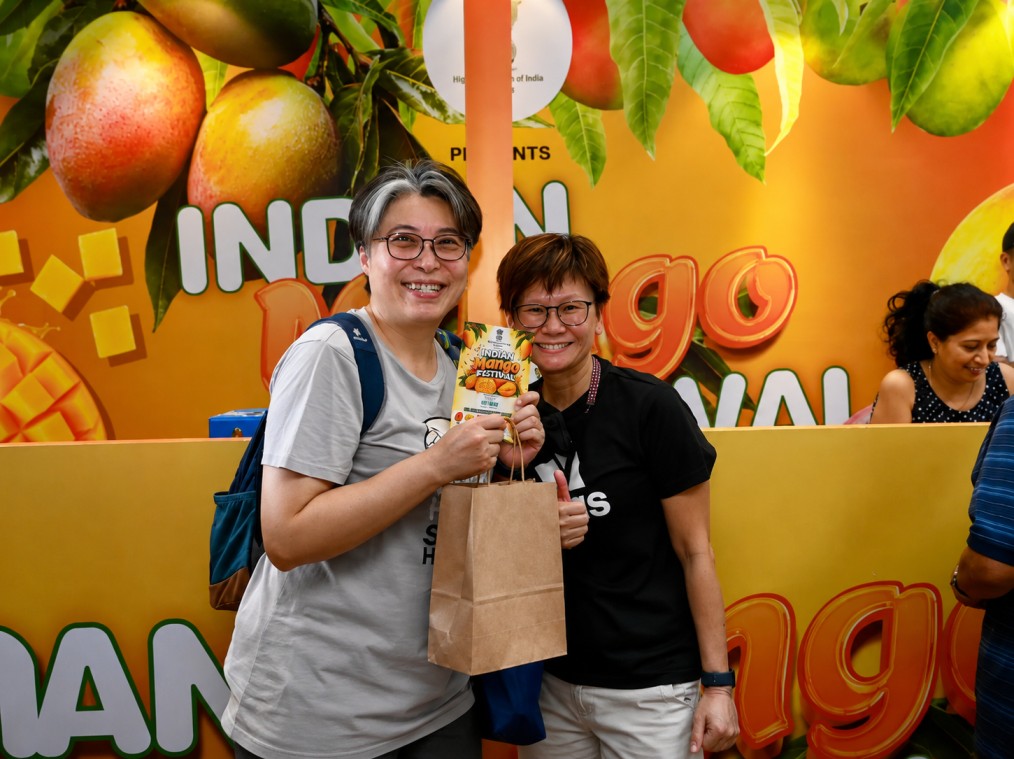
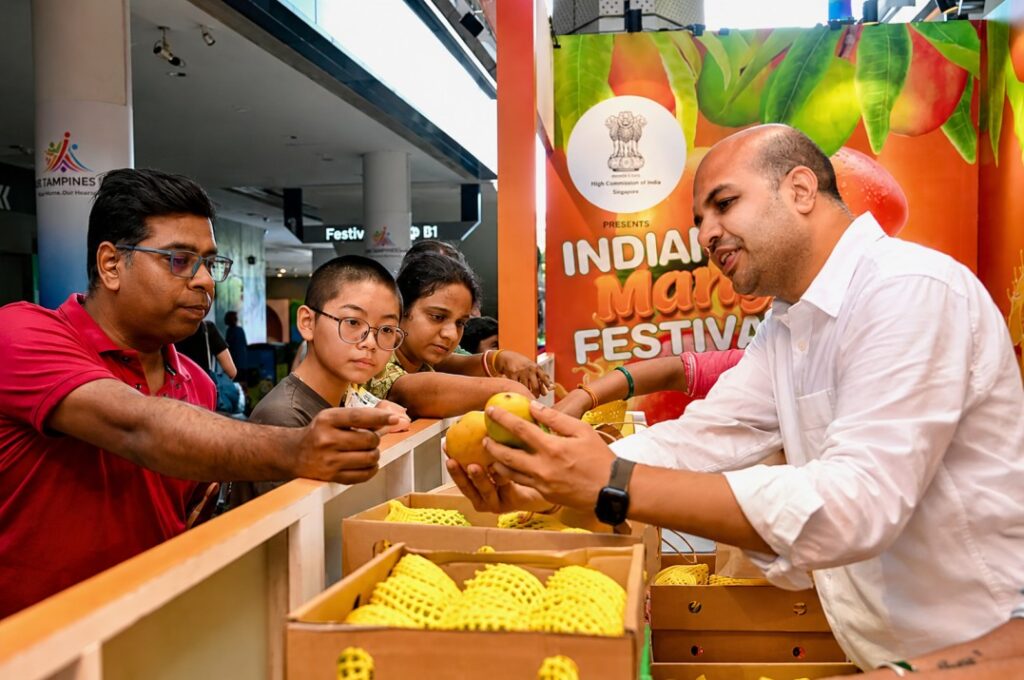
The centrepiece of the 2026 Indian mango Singapore programme was the event at Our Tampines Hub on 1 May 2026. Organised by the High Commission of India in Singapore, the Indian Mango Festival brought together a range of Indian mango varieties, food demonstrations, and consumer engagement in one of Singapore’s most accessible and community-focused public venues.
Our Tampines Hub is not a destination for food enthusiasts. It is a neighbourhood hub serving Singapore’s heartland residential community: families, students, elderly residents, and everyday Singaporeans who use the space for daily activities.
Bringing an Indian mango festival to this environment was a deliberate choice by the High Commission of India to take Indian mango to where Singaporeans live rather than asking Singaporeans to travel to a specialised venue.
Berrydale Foods supplied the mangoes that were at the heart of the festival. Visitors could see, handle, and taste multiple Indian mango varieties side by side.
The visual contrast alone was striking for many visitors: comparing the deep saffron Alphonso with the green-skinned Langra and the golden Kesar on the same table was an immediate demonstration of India’s mango diversity that no amount of description could replicate.
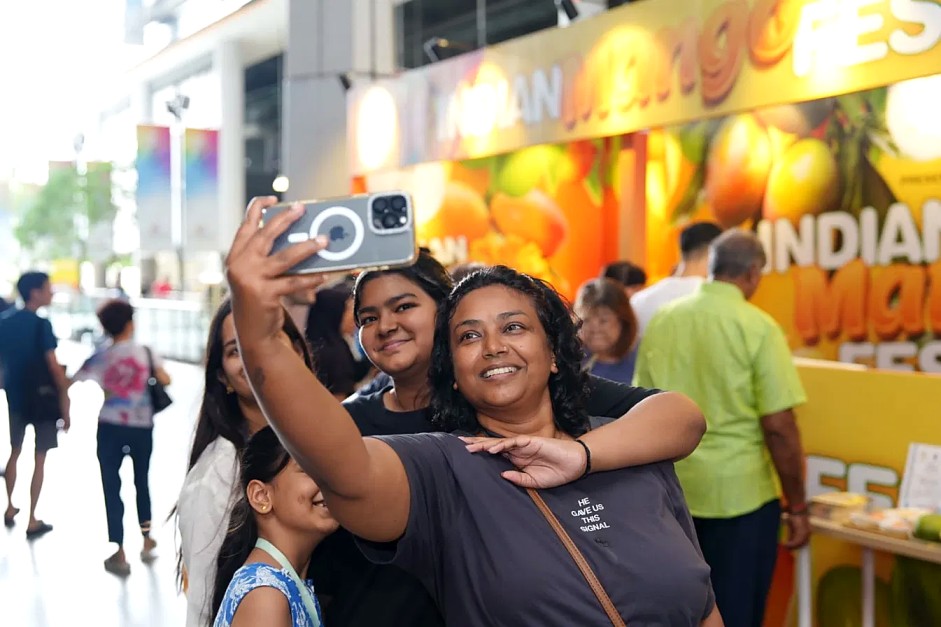
The photographs from the event tell the story clearly. Families with young children discovering varieties they had never encountered. Local Singaporean consumers, not of South Asian origin, sampling Alphonso for the first time and asking where to find it again.
Enthusiastic conversations across language barriers, mediated by a shared curiosity about what each variety tasted like.
The consumer response throughout the festival was positive. The appreciation for quality, sweetness, and variety was consistent across both South Asian diaspora visitors who arrived with a cultural familiarity, and general Singapore public visitors for whom the Indian mango category was largely new territory.
10,000 Consumers and What That Number Represents?
Across the 2026 Indian mango Singapore programme, including retail distribution, the Our Tampines Hub event, and associated activities, Berrydale Foods’ mangoes reached more than 10,000 customers in Singapore.
A number like 10,000 can be read as a logistics figure. It is also a cultural one. Each of those 10,000 customers represents a taste experience that either confirmed or built a relationship with Indian mango for the first time.
For customers who already knew Alphonso, encountering Langra or Himayat or Rasalu for the first time extended that relationship into territory they had not explored before. For customers encountering any Indian mango for the first time, the 2026 programme was their introduction to a category they were not previously aware existed at this quality level.
The feedback from the 2026 season was encouraging across three consistent themes: quality, sweetness, and variety. These are the three dimensions that the Berrydale Foods quality process, Brix testing standard, and multi-variety programme were specifically designed to deliver.
That the consumer response matched the intent is not coincidental.
Why Singapore and Why Now?
Singapore is one of the world’s most food-sophisticated markets. It is a city-state where culinary exploration is a cultural norm rather than a hobby, where premium food retail is well-developed, and where the South Asian community has the scale and purchasing power to sustain a meaningful Indian mango programme year after year.
The buy Indian mango Singapore market is not yet mature. Competition from Thai, Philippine, and South American mango varieties means that Indian mango, despite its flavour superiority in the premium segment, has to earn its place through consistent quality, consumer education, and the kind of direct engagement that events like Our Tampines Hub and Mango Fiesta make possible.
The 2026 season demonstrated that the Indian mango festival Singapore format works. Indian mango Singapore events create engagement that retail distribution alone cannot.
When Singaporean consumers, regardless of cultural background, are given access to properly selected, correctly graded, and well-presented Indian mangoes across multiple varieties, the response is consistently positive.
For Berrydale Foods, Singapore is a long-term commitment, not a seasonal transaction. The 2026 programme built on 2025. The 2027 programme will build on 2026.
Each season adds to the foundation of consumer awareness, trade relationships, and market understanding that makes the Alphonso mango Singapore premium viable in the long term.
The Broader Vision
The Singapore story is one part of Berrydale Foods larger mission: connecting premium Indian produce with global consumers who deserve to know what India’s agricultural diversity actually looks and tastes like.
India is the world’s largest producer of mangoes. The country grows over a thousand varieties across 29 states. The international market knows, at best, two or three of them. There is an enormous gap between what India produces and what the world has access to. Closing that gap, variety by variety, market by market, event by event, is what every season in Singapore is working towards.
For importers and wholesale buyers looking to grow their Indian mango Singapore operations and reach the broader Southeast Asian market, see our full export range and compliance documentation at the Alphonso Mango Exporter hub. For a comparison of the two most internationally recognised varieties, see the Alphonso vs Kesar Mango guide. For year-round processed format options including frozen and freeze-dried Alphonso, see the IQF Mango Exporter page.
Contact Berrydale Foods for Singapore and Southeast Asia Supply Enquiries – 91-8142019112